Supporting Statement A
0704_0644_SSA_SMS_3.11.2024.docx
DoD-wide Data Collection and Analysis for the Department of Defense Qualitative and Quantitative Data Collection in Support of the Independent Review Commission on Sexual Assault Recommendations
Supporting Statement A
OMB: 0704-0644
SUPPORTING STATEMENT - PART A
DoD-wide Data Collection and Analysis for Department of Defense Qualitative Data Collection in Support of the Independent Review Commission on Sexual Assault Recommendations (OMB Control Number 0704-0644)
Title of Collection: Developing Healthy Masculinity Social Marketing Strategies through Focus Groups and Pilot Testing
Expected Fielding Dates: 15 March 2024 – 15 April 2024
1. Need for the Information Collection
In 2021, at the direction of President Biden, Secretary of Defense Lloyd Austin ordered an Independent Review Commission (IRC) to review sexual assault in the military and provide recommendations to remedy the issue within the Department of Defense. An umbrella OMB package (0704-0644, “DoD-Wide Data Collection and Analysis for the Department of Defense Qualitative and Quantitative Data Collection in Support of the Independent Review Commission on Sexual Assault Recommendations”) has already been submitted; this package provides information about a specific collection. In issuing their report, among other recommendations, the IRC advised that the Under Secretary of Defense for Personnel and Readiness “should commission research on gender and masculinities to develop effective social marketing strategies to facilitate primary prevention efforts” (Recommendation 2.6.d; see Appendix A). This effort was directed in the September 22, 2021 Secretary of Defense Memorandum, “Commencing DoD Actions and Implementation to Address Sexual Assault and Sexual Harassment in the Military” (see Appendix B). The link between hegemonic masculinity and sexual assault and sexual harassment (SASH) has long been documented (e.g., Vechiu, 2019). Our project aims to identify the most effective social marketing campaign materials and messages to promote healthy masculinities and bystander intervention as part of the Department’s larger mission to reduce SASH in the military.
This effort focuses on hearing the perspectives of male Service members, as they are the target audience of the campaign. However, we acknowledge the narrowness of this scope, as women and transgender Service members of all kinds can make meaningful contributions to the conversation. However, the IRC recommendations focused on men as the intended target audience of the campaign. We want to better understand what kinds of messages resonate the most with them based on their experiences and identities. The focus on men allows for the exploration of perceived expectations, norms, and behaviors of men without the additional layer of gender identity complexities that might be present in a mixed-gender group. Additionally, focusing on positive masculinities with men will provide clarity around negative societal patterns that stereotype certain traits as masculine which may be harmful to women and marginalized genders and sexualities.
2. Use of the Information
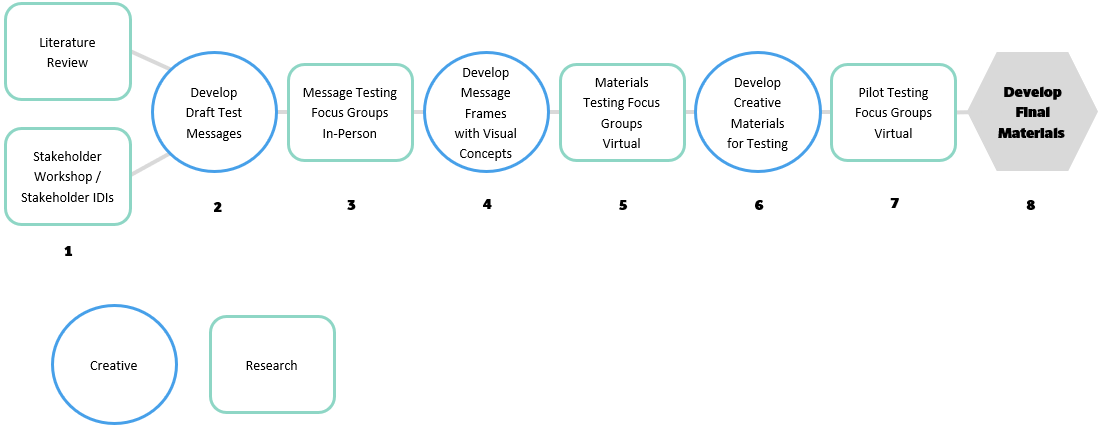
The Office of People Analytics (OPA) will use this information collection effort to test messages and materials (e.g., posters, digital assets for sharing on social media) for a social marketing campaign by conducting in-person and virtual focus groups with the target audience for the campaign (Service members who are men). We will use an iterative approach, as shown in Figure 1 below, to develop, test, and disseminate campaign materials. More specifically, we will conduct up to 76 90-minute focus groups at up to 18 CONUS installations over the course of three discrete phases (steps 3, 5, and 7 in Figure 1) to iteratively test and refine creative concepts and materials. The first phase of focus groups will be conducted in person on military installations. The second and third phases of focus groups will be conducted virtually using zoom.gov.
For the first round of focus groups, we will test up to 5 draft message frames that have been approved by the government project manager. After the first round of focus groups concludes, we will refine and build upon these messages to develop up to 5 message frames and visual concepts. These message frames and associated visual concepts will be tested in the second round of focus groups. Finally, based on feedback from the second round of focus groups, we will develop draft products for testing in a third round of focus groups. These products may include print materials, like posters or postcards, and digital assets, like social media graphics and executions.
Figure 1. Iterative Research and Creative Design Approach
Focus group locations will be finalized in coordination with OPA, the Services, and the DOD Sexual Assault Prevention and Response Office (SAPRO). At each installation, four focus groups will be conducted, segmented by rank, given the influence this variable has on participation, engagement, and candor in group discussions. Specifically, a group of junior enlisted members (E1-E4), mid-level enlisted members (E5-E6), senior enlisted members (E7-E9), and junior officers (O1-O3) will be held at each location. Soft recruitment quotas will be developed for branches (including National Guard), and race.
For in-person groups, we will recruit up to 10 individuals to ensure that each session holds up to 8 participants; for virtual groups, we will recruit up to 8 individuals to ensure that each session holds up to 6 participants. Virtual focus group discussions of up to six participants each will be large enough to avoid rapid exhaustion of opinions and encourage interaction from diverse perspectives, but small enough to allow each participant to speak virtually. We assume recruiting will take up to 3 weeks per round.
The project objectives—promoting behaviors like bystander intervention as a way to engage men as allies in the fight against SASH—complement one of the Centers for Disease Control and Prevention’s recommended key strategies for preventing sexual violence, specifically, promoting social norms that protect against violence. To inform our approach to the development of social media messaging, we will use the framework of social norms theory (SNT), also known as the social norms approach. SNT emphasizes the role that peer norms and beliefs about those norms—whether the beliefs are accurate or not—play in an individual’s attitudes and behavior. For example, an individual might believe that his peers are unlikely to intervene in a situation where SASH might occur, and therefore be less likely to intervene himself even though he believes that intervention is the right thing to do. Using the SNT framework, we will develop messages designed to correct misperceptions of perceived norms (e.g., that others are unlikely to intervene) and promote healthy, desired norms (e.g., that many people are willing to intervene, and it is the right thing to do). SNT has been widely used within the context of social marketing,1 including to develop a successful social norms sexual violence prevention marketing campaign on a college campus. Over a 5-year evaluation period, the campaign was associated with an increase in positive perceptions of peers’ attitudes and beliefs, self-reported positive attitudes and beliefs, and self-reported prosocial behaviors.2
As noted above, this effort focuses on hearing the perspectives of male Service members, as they are the target audience of the campaign. To develop persuasive and evidence-based messages, we first need to construct messages tailored to our intended audience, and therefore, to better understand what kinds of messages resonate the most with men, we need to hear directly from them. The focus on men allows for the exploration of perceived expectations, norms, and behaviors of men without the additional layer of gender identity complexities that might be present in a mixed-gender group. Additionally, focusing on behaviors and opinions experienced by men will provide clarity around negative societal patterns that may be harmful to women and marginalized genders and sexualities.
Respondents will be invited to participate via email (included in this package) by Service/installation POCs. Notes and audio recordings from the focus groups will be analyzed by members of the contractor team. No statistical analysis will be conducted.
For both in-person and virtual focus groups, we anticipate a minimum of 2 days of data collection and recommend a make-up day at each installation, for a total of 3 days of data collection at each location. All three rounds of focus group data will be collected over the course of 12 weeks to avoid overlapping data collections and to allow data from focus groups to be strategically and iteratively analyzed to identify and create materials that can be tested. All focus groups will be facilitated by a RIVA-trained moderator, and one notetaker will be present to capture notes in real-time. RIVA is an award-winning training institute that specializes in training moderators to conduct qualitative market research. Additional Government staff from the team may be present to observe the groups. All focus groups will be electronically recorded and transcribed.
Before fielding, we will conduct two focus group dry runs with the moderator and notetaker teams to ensure protocol questions and follow-up probes are administered consistently across the entire data collection. In addition to ensuring the focus group and interview protocols are clear and respectful to the target audience, the dry runs will test the structure, activities, and timing of the protocols to ensure that the primary data collection progresses as intended.
For each of the three rounds, we will prepare an interim briefing of high-level themes captured from a rapid analysis of the notes. More specifically, topline elements (e.g., phrases that resonated with respondents, attention-grabbing concepts, appealing visuals) will be synthesized to support the refinement of the creative materials. Following all three rounds of testing, transcripts will be coded and analyzed using qualitative analytic software (i.e., NVivo) to capture nuanced thematic differences between ranks and Services, and to provide illustrative quotes.
3. Use of Information Technology
Zero percent of the initial round of focus groups will be conducted in person. The second and third rounds of focus groups will be conducted virtually to reduce cost burdens related to conducting in-person focus groups and expand the reach of this research. All recruitment and submitted correspondence (e.g., consent information sheets) will be handled virtually (e.g., via email). In the second and third rounds of focus groups, we anticipate that 100% of correspondence will be handled electronically. We will only capture electronic submission of ranking sheets which will be de-identified. No PII will be captured by our team electronically.
4. Efforts to Identify Duplication
The information obtained through this collection is unique to the messages and materials being developed for this project and is not already available for use or adaptation from another cleared source.
5. Burden on Small Businesses
This information collection does not impose a significant economic impact on a substantial number of small businesses or entities.
6. Consequences of Less Frequent Collection
This effort is a one-time data collection. Without the information collection requested for this project, the messages and materials for the social marketing campaign will not be tested by the target audience before being distributed, increasing the likelihood that they would be ineffective or poorly received by the target audience. This effort also contributes to the fulfillment of IRC Recommendation 2.6.d. (see Appendix A) as directed by the September 22, 2021 Secretary of Defense Memorandum, “Commencing DoD Actions and Implementation to Address Sexual Assault and Sexual Harassment in the Military” (see Appendix B).
7. Paperwork Reduction Act Certification
This collection of information does not require collection to be conducted in a manner inconsistent with the guidelines delineated in 5 CFR 1320.5(d)(2).
8. Solicitation of Comments
A 30-Day Federal Register Notice for the collection published on Monday, March 11, 2024. The 30-Day FRN citation is 89 FR 17445.
No additional consultation apart from soliciting public comments through the Federal Register was conducted for this submission.
9. Gifts or Payment
No payments or gifts are being offered to respondents as an incentive to participate in the collection.
10. Confidentiality
A Privacy Act Statement is not required for this collection because we are not requesting individuals to furnish personal information for a system of records.
A System of Record Notice (SORN) is not required for this collection because records are not retrievable by PII.
A Privacy Impact Assessment (PIA) is not required for this collection because PII is not being collected electronically.
The data set files are temporary. Cut off upon completion of research project. Destroy 30 years after cutoff.
Public use collection data that has been de-identified are permanent. Cut off annually or upon issuance of final report, analysis, survey study, or similar assessment. Transfer to NARA 30 years after cutoff.
11. Sensitive Questions
While the campaign messages and materials being discussed in the focus groups will address topics related to sexual assault and sexual harassment (SASH), the focus groups are intended to elicit reactions to the messages and materials developed for the campaign. Participants will not be asked about their personal experiences or behavior related to SASH. Questions about participants’ reactions to and opinions of the messages and materials are central to the purpose of this information collection.
12. Respondent Burden and its Labor Costs
Part A: ESTIMATION OF RESPONDENT BURDEN
Collection Instrument(s)
Developing Healthy Masculinity Social Marketing Strategies
Number of Respondents: 504
Number of Responses Per Respondent: 1
Number of Total Annual Responses: 504
Response Time: 1.5 hours
Respondent Burden Hours: 756 hours
Total Submission Burden (Summation or average based on collection)
Total Number of Respondents: 504
Total Number of Annual Responses: 504
Total Respondent Burden Hours: 756 hours
Part B: LABOR COST OF RESPONDENT BURDEN
Collection Instrument(s)
Developing Healthy Masculinity Social Marketing Strategies
Number of Total Annual Responses: 504
Response Time: 1.5 hours
Respondent Hourly Wage: $27.68
Labor Burden per Response: $41.52
Total Labor Burden: $20,926.08
Overall Labor Burden
Total Number of Annual Responses: 504
Total Labor Burden: $20,926.08
* Hourly pay is the monthly pay rate divided by 173. Monthly pay rate from https://militarypay.defense.gov/Portals/3/Documents/2023%20Basic%20Pay%20Table.pdf.
13. Respondent Costs Other Than Burden Hour Costs
There are no annualized costs to respondents other than the labor burden costs addressed in Section 12 of this document to complete this collection.
14. Cost to the Federal Government
Part A: LABOR COST TO THE FEDERAL GOVERNMENT
Collection Instrument(s)
Developing Healthy Masculinity Social Marketing Strategies
Number of Total Annual Responses: 504
Processing Time per Response: 1.5 hours
Hourly Wage of Worker(s) Processing Responses: $27.68
Cost to Process Each Response: $41.52
Total Cost to Process Responses : $20,926.08
Overall Labor Burden to the Federal Government
Total Number of Annual Responses: 504
Total Labor Burden: $20,926.08
Part B: OPERATIONAL AND MAINTENANCE COSTS
Cost Categories
Equipment: $0
Printing: $0
Postage: $0
Software Purchases: $0
Licensing Costs: $0
Other (travel for focus groups): $42,840
Total Operational and Maintenance Cost: $42,840
Part C: TOTAL COST TO THE FEDERAL GOVERNMENT
Total Labor Cost to the Federal Government: $20,926.08
Total Operational and Maintenance Costs: $42,840
Total Cost to the Federal Government: $63,766.08
15. Reasons for Change in Burden
This is a new collection with a new associated burden.
16. Publication of Results
The results of this information collection will not be published.
17. Non-Display of OMB Expiration Date
We are not seeking approval to omit the display of the expiration date of the OMB approval on the collection instrument.
18. Exceptions to “Certification for Paperwork Reduction Submissions”
We are not requesting any exemptions to the provisions stated in 5 CFR 1320.9.
1 Burchell, K., Rettie, R., & Patel, K. (2013). Marketing social norms: Social marketing and the ‘social norm approach.’ Journal of Consumer Behaviour, 12(1), 1–9. https://doi.org/10.1002/cb.1395
2 Mennicke, A., Kennedy, S. C., Gromer, J., & Klem-O’Connor, M. (2021). Evaluation of a social norms sexual violence prevention marketing campaign targeted toward college men: Attitudes, beliefs, and behaviors over 5 years. Journal of Interpersonal Violence, 36(7–8), NP3999–NP4021. https://doi.org/10.1177/0886260518780411
| File Type | application/vnd.openxmlformats-officedocument.wordprocessingml.document |
| Author | Agyeman, Nana B CTR WHS ESD |
| File Modified | 0000-00-00 |
| File Created | 2026-01-07 |
© 2026 OMB.report | Privacy Policy